By A. Crawford 2/10/2026
Ricky Anderson arrives at Dunfermline’s East Port Bar shortly after opening on a Monday lunchtime. Still running on the alcohol and ecstasy of a weekend that began in a blur at the Kronk nightclub in Cowdenbeath and staggered through to Sunday’s chemical top-ups, he has somehow found the strength to attend Monday Club. The Kronk was at the heart of the early ‘90s rave scene where ecstasy-fuelled dance music which promoted a euphoric sense of unity in which the crowd were just mellow with no judgement.
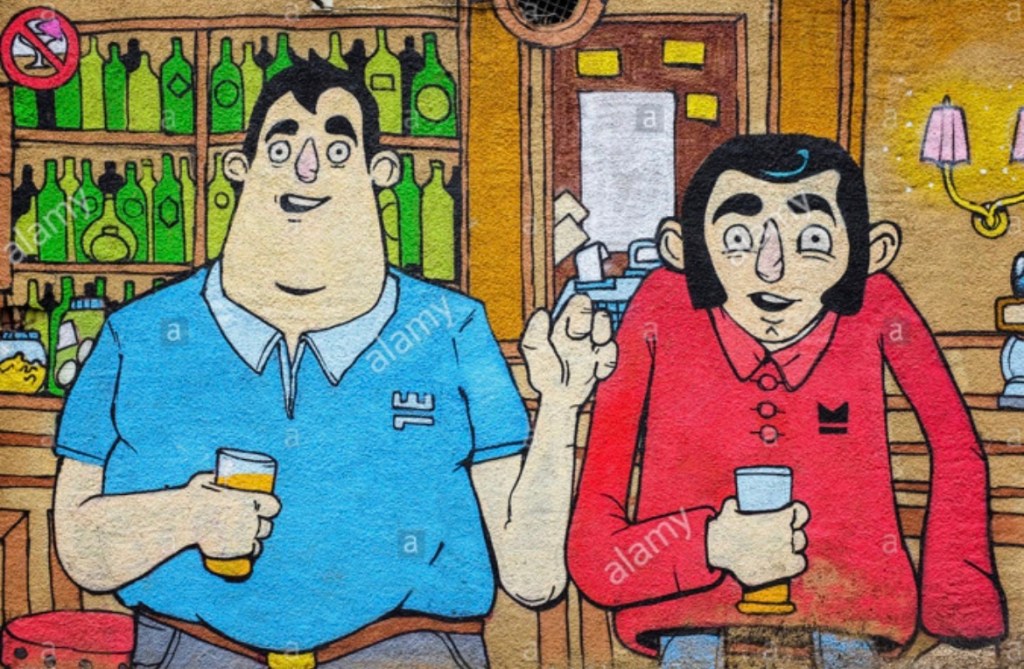
At the bar stands Trigger Hume, a peculiar pint-side philosopher and near-daily regular who reminds Ricky of Sid James from the Carry-On films. He wears his usual black shirt with silver collar tassels like something Johnny Cash would wear, matched by jet-black dyed hair. Always ready with a fact or an argument, he is debating whether fish suppers are still worth the price. “Fish suppers are a rip-off these days, no worth the money!” he tells barman Raymond Ballentyne. Dressed in an AC/DC T-shirt, his bald head gleaming, Raymondo counters, “Well, ye need tae consider the cost of fish, the staff cooking it and the electricity.”
As Ricky listens to the debate on takeaway economics, he cannot decide which of the three, including himself, is the most normal. After a weekend on ecstasy pills, he finds ordinary conversations strange, especially those heard at work or in an average pub. Ricky has skipped work today to attend Monday Club at the East Port. Normally, he would be in Ladbrokes farther along the street, listening to the everyday exchanges between staff and punters. With the weekend’s ecstasy pills still in his system, however, even ordinary people seem like oddballs. He prefers the East Port’s outlandish claims and rambling conversations to the forced exchanges of the workplace. At work, particularly after a weekend on narcotics, he feels obliged to play the game and go along with everything. Here, he can simply let the nonsense flow, choosing whether to join in or merely listen.
Trigger spots Ricky at the bar and flicks a thumb in his direction and says, “He’ll tell ye,” drawing him into the argument.
“I haven’t eaten in three days and still don’t feel like it, so I’m probably not the best person to ask,” Ricky replies.
Raymond looks at Ricky. “I suppose you’ve been chewing chuddy and drinking Coke up at that happy club, the Kronk?”
Trigger erupts into his cackling laugh at Raymondo’s remark, despite having no idea what he is talking about.
As he polishes the pint glasses and, judging by the shine, perhaps his bald head as well, Raymondo decides to explain what he meant by the “happy club” at the Kronk. “Aye, they awe take illegal substances up at the place in Cowdenbeath and stay awake for days. They dinnae drink anything apart fae water or cola,” he tells Trigger. “What? Like smokin’ drugzz, like?” Trigger asks as he turns towards Ricky and stares at him with a broad, daft, bewildered grin.
Another fixture at the bar is East Port Bob, named for his near-constant presence. What began as a joke now seems to please him, as though it confirms his status as the pub’s main man. He stands in his usual tweed blazer, with the remains of a 1950s Teddy Boy quiff slicked in Brylcreem despite his half-bald head. Before long, he launches into a story about Jock Stein’s time as Dunfermline manager, when Stein supposedly visited the East Port during the week to find out whether any of his players had been drinking there. “Aye, Jock would come in and ask me if I’d seen any of the players in the pub that day, and I would be his wee mole and report back to him,” Bob boasts to the regulars at the bar.
East Port Bob and Trigger are partners in crime when it comes to pint-side philosophy although they often fall out once the ale and whisky begin to take their toll. Raymondo behind the bar is keeping the pub vibe going by quietly playing music, just a selection of CD’s, some of them a mix from the ‘70s and ‘80s. At this point that high energy track from back in 1979 comes on, that Born to be Alive by Patrick Hernandez. The track hits the room with an uplifting energy …
People ask me why
I never find a place to stop
And settle down, down, down
But I never wanted all those things
People need to justify
Their lives, lives, lives
Coz we were born to be alive
We were born to be alive
Born, born to be alive!
Trigger begins shuffling his feet, then dancing as though he is steering a car through a bend then flicking his hands in front of him as if dealing cards around a poker table. Looking up at the regulars gathered around the bar, he announces, “See yon record?” he declared. “Aye, well, back in 1980 at Jackie O’s in Kirkcaldy. Vodka and coke in hand tae. Nane o’ yer smoking f*ckin’ drugzz up at this happy club yer talking aboot.” East Port Bob gazes wistfully into the distance and nods in agreement. “Aye, marvellous years, Trig.” Ricky Anderson simply lets the conversation flow, knowing he could never compete with Trigger’s instinct for one-upmanship.
And there he is, the most peculiar character of them all, approaching the East Port Bar, the Yard Animal. Some would call him unhinged, although he is always immaculately dressed in his paisley cravat. His arrival follows a familiar ritual as he eases the pub door slightly ajar, poking his head through the gap, and greets everyone with a trumpet-like “BUUURRRPPP!” Trigger and East Port Bob are rolling their eyes as Trigger calls out “Ach, here’s this Arsehole”. The Yard Animal would tell a joke or make a random remark, only to follow it with a sheep-like laugh of “mehhhhh”. Every so often, he would slip into a scouse accent and announce to the crowd, “It’s grrrrrreat here, innit?” Ricky found this comical and would encourage it by being the only one laughing, he loved off the wall character’s mainly out of boredom and a midweek dollop of melancholy. He not only enjoyed the Yard Animal’s eccentric behaviour but also took great pleasure in watching the reactions of others in the bar. The Yard Animal’s off the wall quirky personality was, no doubt, influenced by his LSD use during the 1970s. Ricky could relate and connect with it. Back in the 1970s, the Yard Animal had played in a band called The Fireman. He liked to imagine himself as Sting from The Police, although they eventually chose a different title inspired by another branch of the public services. The band played only pub gigs around Dunfermline, but its members’ excessive drug use ultimately led to its downfall. Each time the Yard Animal would tell a story and let out his laugh the other regulars would often say to Ricky, “dinnae encourage him for f*ck sake”.
Trigger Hume, East Port Bob, the Yard Animal and Raymondo the barman formed the core cast of characters who frequented the East Port Bar. They had many sayings and greetings and some that would either make Ricky chuckle or cringe. East Port Bob would loudly declare. “Cheers now” after receiving his drink at the bar as though thanking Raymondo for a life-saving act. Then Bob and Trigger had a habit of greeting arriving regulars by enthusiastically shouting out, “Er he is tho”. Although a lot of the time, the unfortunate arrival would suddenly make the regular become self-conscious, wondering if they had just interrupted a conversation about themselves. The collective also had an odd fascination, with asking each other, “whit time are oo?” when there was a clock stood steady above the bar. They would convince and call themselves, “the all-time greats” like they were some kind of retired legends. If discussing someone who wasn’t present, Trigger would inevitably shake his head and say, “Aye, of course they’re no in the all-time greats, like us.”. The all-time greats, who do sweet f*ck all, all day with endless pint side philosophy, playing dominoes and arguing with each other.
One local celebrity, however, had a habit of ruining the ambiance in the pub on an altogether bigger scale was “Wheel (Barrie) Bacon”. He earned his nickname from his exaggerated hard-man swagger with arms held rigidly away from his sides, as though pushing a wheelbarrow or carrying a basketball under each arm. Here he is, striding into the pub in his trademark yellow “Dunfermline Gym” vest, pushing his invisible wheelbarrow. His stories always seem to start and finish with the same theme. Along the lines of an alleged confrontation in which he “put them in their place”. He also considers himself God’s gift to women, believing they will fall at his feet when he shouts compliments about the colour of their dresses. “Nice black number” is his usual line. Radio silence from the ladies is the normal response.
He was already on his final warning from the pub for bullying behaviour and for repeatedly spinning wildly exaggerated stories designed to inflate his own reputation. He didn’t do normal conversation and never greet anyone with a “hello” it was always straight into a story for self-indulgence. Incidentally, Wheelbarrie is also employed as a steward at the Kronk nightclub, which Ricky regularly attends.
The self-proclaimed all-time greats at the bar are starting to shuffle away as they have no liking for him. Wheelbarrie starts telling a tale but is quickly exposed as he claims that, on Saturday night at the Kronk, he confronted four lads for grabbing women’s backsides and spraying them with beer. “Aye,” he declares, “ah grabbed the four o’ them and launched them oot the door, one by one. The last yin wis the trickiest, mind. Ah hooked ma finger through his trooser belt loop and flung him straight oot efter the rest.”
“Ehhhhh, hawd oan Bacon!! Coo on the line.” Raymondo Ballantyne says, stopping the conversation. “That club night at the Kronk has nae trouble whatsoever,” he said. “The place is full o’ folk on ecstasy pills. They spend mair time hugging each other than arguing. Ye could leave the bouncers at hame and naebody would notice.” Ricky Anderson nods in agreement and tells Wheelbarrie, “Aye,” he said matter-of-factly. “Ah wis there on Saturday night, and nothing like that happened at awe.” The collective at the bar sigh, shake their heads, and exchange weary looks while the Yard Animal lets out his sheep-like “mehhhhh” from the side. Raymondo seems to be at the end of his tether. “Right, Bacon,” he barked, pointing towards the door. “ye can take yersel’ and that wheelbarrie straight oot that door. And dinnae bother showin’ yer face in here again, because we’re aw sick tae the back teeth o’ yer compulsive pathological mendacity!” Wheelbarrie instantly goes on the defensive. His face is giving it that familiar square-go-now expression as he glares across the bar and fires back: “Whit the f*ck is mendacity like?” he snaps. “Am no a f*cking mendacity! You lot are if onybody is”. The bar has now fell silent and Raymondo is shaking his head and rubbing his eyes in despair.
Trigger Hume has taken it upon himself to deal with the situation. Grabbing Wheelbarrie by the arm, he began hauling him towards the door. At the same moment, and there’s Raymondo “Mr Sheen Head” Ballantyne coming charging out from behind the bar, eager to lend a hand. Together, the pair frogmarched a protesting Wheelbarrie across the pub and towards the exit, while the regulars looked on in amusement.
The following week Ricky finds himself back at Monday Club. The usual suspects are already assembled in the East Port. With little else to occupy them, they’ve invented a gambling game that only a pub full of regulars could find entertaining: ten-pence bets on the colour of the next car to pass the window. Trigger and East Port Bob seem to be the most passionate about this competition. And there’s the Yard Animal laughing away like a lamb to the slaughter. Raymondo is behind the bar and this week, he’s sporting a faded black Guns N’ Roses T-shirt stretched across his shoulders. He rolls his eyes and says “awfy boys eh”. Turning to Ricky, he asks how the Kronk was on Saturday night. Aye it was tops Raymond Ah wis right on one.”
The Yard Animal clocks the conversation with his menacing, narcotic-deviant stare and pulls Ricky away from the earshot of Raymondo. “Div ye hink ye could bring us some o’ these ecstasy tablets, Ricky?” At that, East Port Bob’s ears prick up, and Trigger looks every bit as intrigued. “Aye,” Bob says, suddenly enthusiastic “Ah’d quite fancy tryin’ some o’ that masel’ av smoked Jamican Woodbines before doon at the Rosyth dockyaird so it’s nae bother ae me.” Trigger nods along. “Sounds awright tae me.” So, to join in unison and camaraderie East Port Bob, the Yard Animal and Trigger Hume decided to do their first ecstasy pill with Ricky. “al bring them in next Monday” Ricky tells them with his mischievous grin. This plan was kept strictly between the four of them. Raymondo Mr Sheen Head had no idea about the carry-on that was heading his way.
The following Monday, Ricky arrives at the East Port, keen as mustard. Bob and Trigger are locked into a game of dominoes, while the Yard Animal sits nearby, giggling away at nothing. Each time Trigger wins a game, he pipes up with that Fred Astaire lyric, “It was just like takin’ candy from a baby,” leaving Bob to growl in frustration as the Yard Animal claps his hands and bursts into his mutton-brained laugh. And there’s Raymondo behind the bar again, who looks to be working his way through the heavy metal catalogue; today he wears a black Saxon T-shirt, the band’s name picked out in red above a warrior with eagle wings holding a shield marked with St George’s cross.
Ricky discreetly hands out the ecstasy pills. As the others inspect them, Trigger mistakes the white dove emblem for a wee pigeon. They swallow them and exchange smug glances while Ricky steps back, half expecting what is about to unfold. After about fifteen minutes, he asks, “Are you up there yet?” Unfamiliar with the slang, Bob replies, “Nothing’s happening wi these hings.” Five minutes later, Bob and Trigger seem to find the Yard Animal funny for the first time, affectionately patting his legs as he slurs through his stories and laughs like a lamb.
East Port Bob’s chin is working like a cucumber slicer as he showers everyone with compliments including Raymondo. “Raymond, yer yin o’ the best, the greatest, in fact. Yer in the all-time greats. Get yersel a drink,” he declares, paying for another round. Then he’s telling Raymondo, “see the lights and mirrors in here Raymond, they are astonishing, just sit and admire them eh”. Raymondo is scowling with confusion.
And there’s Trigger Hume whose face seems to have gone purple like he’s been blowing up bus tyres across at the bus station next to the Kingsgate. His black hair dye is now running down his face due to the sweat and he’s sitting rubbing his legs and all he can say at the moment is, “gid aye” like in an agreement that these tablets are good and do work but kinda holding back the effects.
The Yard Animal sits with that ridiculous grin, repeatedly shouting out his obligatory saying, declaring in his Scouse accent, “It’s grrrrreat here, innit?” with a single clap after each repetition. Bob and Trigger agree every time: “Aye, yer right, saaaaan.”
Trigger tells Raymondo to “get the music oan.” Raymondo presses play, and that Bryan Adams’ current number one, Everything I Do (I Do It for You), fills the pub as Ricky stands back to watch the show.
Look into my eyes – you will see
What you mean to me
Search your heart, search your soul
And when you find me there, you’ll search no more
The three amigos are belting out the tune in unison, arms spread wide like the Pope greeting the crowd in St Peter’s Square.
Don’t tell me it’s not worth tryin’ for
You can’t tell me it’s not worth dyin’ for
You know it’s true:
Everything I do, I do it for yoooooo!!
Love is in the air as Trigger tells Bob and the Yard Animal they are “the greatest folk he’s ever seen.” The three pull into a huddle, chanting, “Ohhhh, the all-time greats … oh yer all-time greats,” while Raymondo, Mr Sheen Head, stares from behind the bar in amazement.
Baby don’t fight it feel it!